




BYC AI Powers Smarter Crowd Monitoring During Hyderabad's Ganesh Immersion
- event_available 24 Sep 2026
BYC AI: Bringing AI-Powered Crowd Intelligence to Hyderabad's Public Safety Operations
When thousands of people gather for a major public celebration, every second matters. Police teams need timely information, clear visibility across crowded locations and effective coordination to keep public spaces safer.
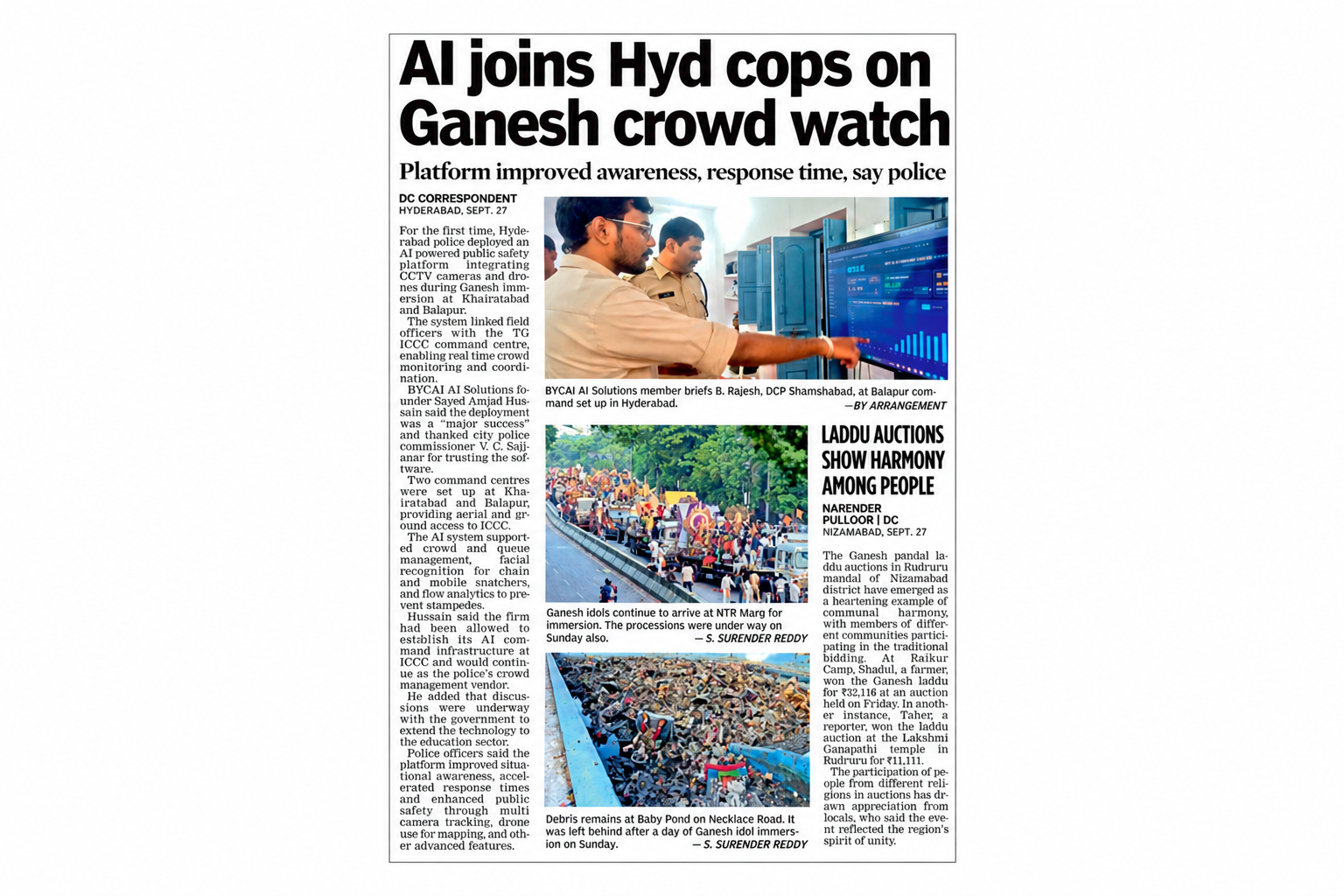
During Hyderabad's 2026 Ganesh immersion celebrations, BYC AI Solutions contributed AI-powered technology to a public safety deployment integrating CCTV cameras, drone surveillance and command-centre operations at Khairatabad and Balapur.
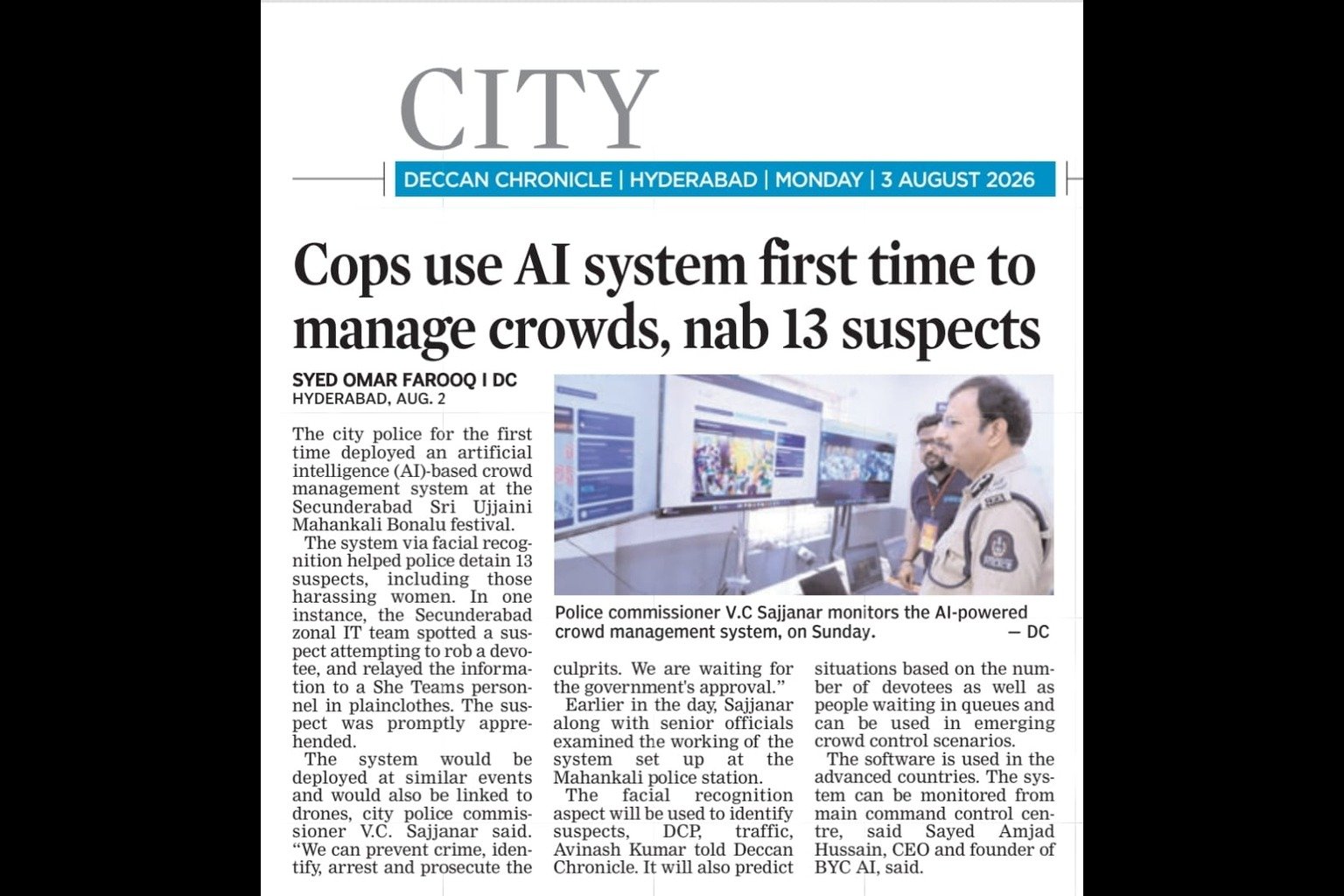
Reported by Deccan Chronicle on September 27, 2026, the deployment highlighted the growing role of artificial intelligence in crowd monitoring, queue management, movement analysis and coordinated policing.
For BYC AI, this initiative represents more than a technology implementation. It demonstrates how AI can be applied to complex, real-world operational challenges, helping authorized teams make better-informed decisions when managing large public gatherings.
At BYC AI, our vision is to move beyond conventional surveillance and make intelligence more actionable. By connecting visual information with AI-powered analytics, we aim to help organizations turn the data they collect into insights that support better awareness, coordination and operational decision-making.
What Happened During Hyderabad's Ganesh Immersion Festival?
Ganesh immersion is one of Hyderabad's major annual public events. Popular locations such as Khairatabad and Balapur attract large numbers of devotees, while processions move through busy roads and gathering points.
Managing these celebrations involves more than deploying police personnel. Authorities must understand crowd movement, identify congested areas, coordinate teams across locations and respond quickly when conditions change.
The scale of the 2026 celebrations highlights the challenge. Police preparations included extensive CCTV coverage, drone surveillance and thousands of personnel supporting security arrangements across the city.
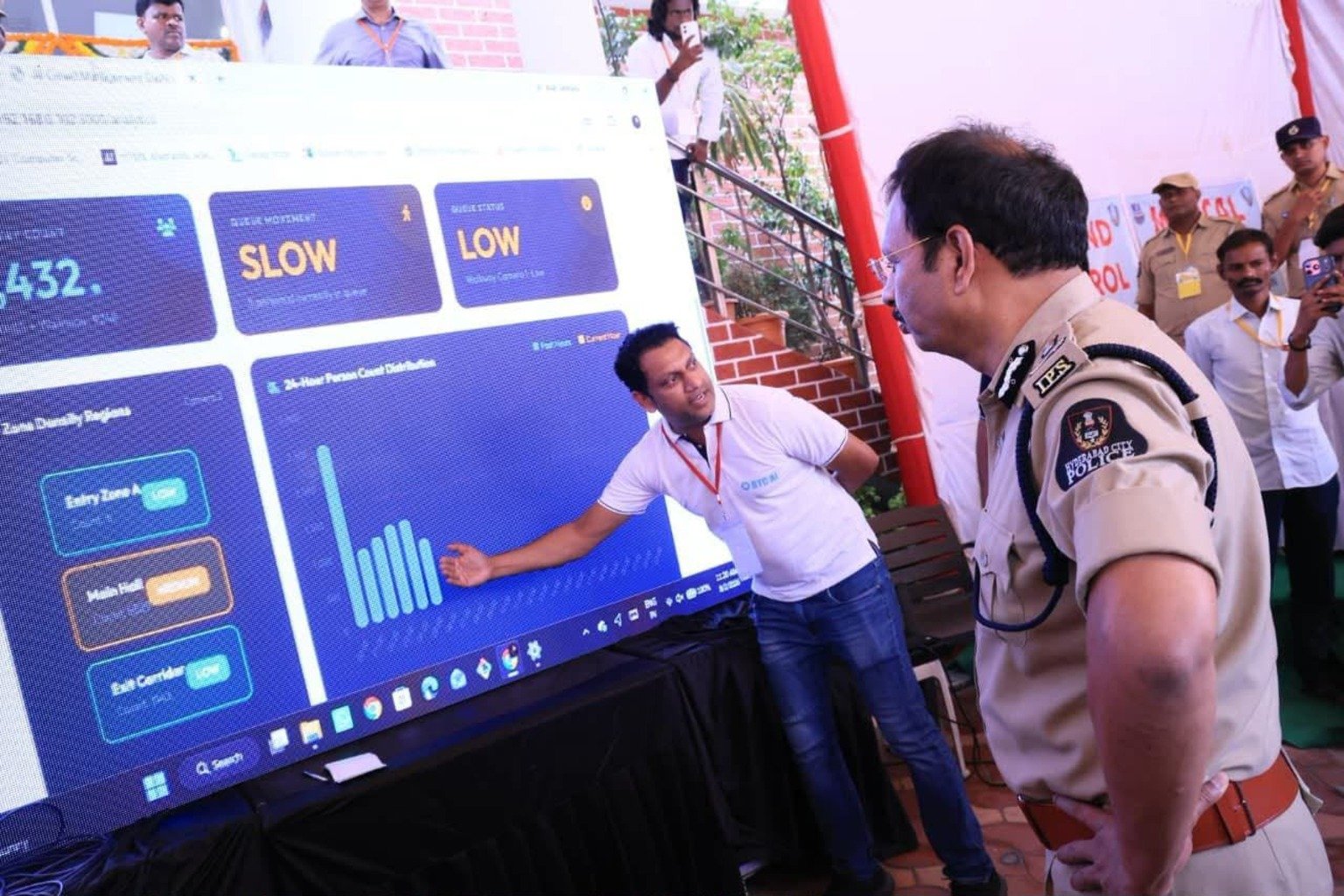
The AI-powered platform deployed at Khairatabad and Balapur was designed to bring relevant surveillance information together. It connected ground-level monitoring with command-centre operations, helping officers obtain a clearer picture of crowd movement.
The Deccan Chronicle report highlighted several capabilities, including multi-camera tracking, crowd and queue management, flow analytics and facial recognition-based watch-list alerts.
The objective was straightforward: help police teams make better-informed decisions when managing large crowds.
Read the original coverage: Deccan Chronicle's report on AI-powered Ganesh immersion crowd control.
How Does an AI Crowd Management System Work?
A traditional CCTV setup allows personnel to view camera feeds and review footage. However, monitoring numerous cameras simultaneously can become difficult during a major public event.
An AI crowd management system adds an analytical layer to the existing surveillance infrastructure. Depending on the system's configuration, it can process video streams, identify patterns in crowd movement and highlight situations that may require attention.
Instead of relying entirely on people to observe every screen continuously, officers can use software-generated insights to prioritize their attention.
A modern AI-powered crowd monitoring system may combine several technologies.
1. Multi-camera crowd tracking
Large events often involve multiple streets, intersections, entry points and exit routes. A single camera cannot provide a complete picture of the entire area.
Multi-camera monitoring helps operators observe different locations through a centralized interface. When supported by suitable analytics, the system can help identify crowd movement patterns across camera feeds.
For police teams, this can make it easier to understand where people are gathering and which areas may require additional attention.
2. Real-time crowd density analysis
Crowd density is an important factor in public safety. When people gather in a limited space, movement can slow down and congestion may increase.
AI video analytics can estimate crowd density in supported camera views and highlight areas that deserve closer monitoring. These estimates can assist officers in evaluating whether access routes need attention or whether crowd movement should be redirected.
Such technology should support decisions made by trained personnel rather than replace on-ground assessment.
3. Queue management and movement analytics
Queues are common at temples, public events, railway stations, exhibitions and large gatherings.
A crowd management platform can help operators understand queue movement, identify slow-moving sections and monitor congestion around entry and exit points.
Flow analytics can also provide insights into how people move through a monitored area. When combined with information from field officers, these insights can support better decisions about crowd distribution and access management.
4. CCTV integration
Ground cameras provide views from fixed positions, while drones can offer aerial perspectives where their use is authorized and operationally appropriate.
Combining these sources can provide a broader understanding of a large event area. Command-centre personnel can review ground-level activity alongside aerial observations to understand changing conditions.
In Hyderabad, the reported deployment brought CCTV cameras and drone surveillance together as part of its public safety approach.
5. Facial recognition and watch-list alerts
The reported platform also included facial recognition capabilities intended to support watch-list alerts.
Such capabilities can help authorized personnel identify potential matches against approved watch lists, subject to system accuracy, operational procedures and applicable law.
However, a match should not automatically be treated as proof of wrongdoing. Human verification, access controls, appropriate oversight and safeguards against mistaken identification are important parts of responsible deployment.
How BYC AI Supported Hyderabad Police During Ganesh Crowd Monitoring
For BYC AI Solutions, the deployment represented an opportunity to apply artificial intelligence to a real-world public safety challenge.
The Deccan Chronicle report described how the platform connected field officers with the Telangana Integrated Command and Control Centre, supporting real-time monitoring and coordination.
Two command-centre setups were established at Khairatabad and Balapur, providing ground-level and aerial visibility through the connected surveillance infrastructure.
The report also described how Sayed Amjad Hussain, associated with BYC AI Solutions, discussed the deployment and how B. Rajesh, DCP Shamshabad, was briefed at the Balapur command centre.
The technology was intended to support police teams with a more coordinated view of activity across monitored areas.
For a city managing major public celebrations, connecting surveillance information with command-centre operations can be valuable. Officers still make the operational decisions, but timely information can help them understand what is happening and where additional attention may be needed.
Learn more about the company's work and technology at BYC AI.
Why Real-Time Monitoring Matters During Large Public Events
One of the biggest challenges in crowd management is that conditions can change quickly.
An area that is manageable at one moment may become congested when multiple groups arrive together. A queue may slow down, traffic may obstruct an access route, or a particular location may require additional police presence.
Without timely information, officers may need to depend on separate camera feeds, radio updates and observations from personnel on the ground.
An integrated monitoring platform can help bring these different sources of information into a more unified operational view.
Better situational awareness
Situational awareness means understanding what is happening, where it is happening and how the situation may develop.
By bringing information from multiple cameras and surveillance sources together, an AI-powered platform can help command-centre personnel build a clearer picture of monitored areas.
Faster assessment of emerging problems
When software highlights congestion or unusual movement patterns, personnel can investigate the relevant area more quickly.
This does not guarantee that every incident will be detected or prevented. Its value depends on the quality of video feeds, analytics performance, connectivity and the response procedures followed by officers.
Improved coordination between teams
Public events often require coordination among police officers, traffic personnel, emergency services and event organizers.
A centralized platform can help ensure that relevant information reaches the appropriate teams. When field observations and command-centre information are shared effectively, authorities can coordinate their response more efficiently.
More informed planning for future events
Crowd analytics can also provide information that helps planners review an event after it concludes.
Depending on the system's capabilities and data-retention policies, aggregated movement patterns and congestion observations may help authorities evaluate routes, access points and staffing arrangements for future celebrations.
AI Video Analytics: Moving Beyond Traditional CCTV Monitoring
CCTV remains an important part of public safety infrastructure. However, installing cameras is only one part of an effective monitoring strategy.
The next step is making the available information more useful.
AI video analytics software can help transform video feeds into operational insights. Depending on the features deployed, these insights may include crowd-density estimates, queue observations, movement patterns and alerts for events requiring human review.
For example, imagine a busy public entrance where people are arriving faster than they can move through the available space. A suitably configured system may flag increasing congestion, allowing operators to assess the situation and notify personnel nearby.
The technology does not make decisions in isolation. Its effectiveness depends on trained operators, clear procedures and the ability to respond to the information it provides.
This combination of cameras, analytics, communication systems and human judgment is what makes an integrated surveillance platform useful.
For organizations exploring AI video analytics software, it is worth evaluating not only detection capabilities but also reliability, compatibility with existing cameras, alert accuracy, cybersecurity and the availability of operational support.
Where Can AI Crowd Management Solutions Be Used?
Although the Hyderabad deployment focused on Ganesh immersion, the underlying approach has applications across several sectors.
Religious festivals and public celebrations
Large religious gatherings require coordination around entry points, queues, pedestrian routes and emergency access. Crowd monitoring technology can help authorized teams observe changing conditions across multiple locations.
Concerts and sporting events
Stadiums, concert venues and entertainment grounds may experience sudden changes in crowd density. AI-assisted monitoring can support venue teams as they assess entrances, exits and busy gathering points.
Railway stations and transport hubs
Stations experience fluctuating passenger volumes throughout the day. Crowd analytics can help operators understand congestion around platforms, ticket counters and pedestrian corridors.
Shopping malls and commercial spaces
Retail properties may use video analytics to understand footfall, monitor queues and improve the management of shared public spaces, subject to privacy requirements and appropriate notices.
Educational institutions
Schools, colleges and universities also need effective systems for managing movement during major events, examinations and emergency situations. Depending on the use case, AI-enabled monitoring can support authorized safety teams in identifying congestion and coordinating assistance.
The Deccan Chronicle report noted that discussions were underway about extending the technology into the education sector. Any future deployment would need to account for the specific needs, privacy expectations and safeguards appropriate to that environment.
What Should Organizations Look for in Crowd Management Software?
Organizations considering crowd management software should evaluate the complete solution rather than choosing a product based on a single feature.
Here are several factors worth considering.
Integration with existing infrastructure: The software should be compatible with the organization's cameras, networks and monitoring arrangements wherever possible.
Real-time performance: Delayed alerts can reduce the usefulness of analytics during rapidly changing situations. Test the platform under realistic network and workload conditions.
Accuracy and reliability: Ask how the system performs in crowded scenes, low-light conditions and areas with partial camera obstruction. Request relevant testing results instead of relying only on demonstrations.
Centralized monitoring: A practical interface should help operators understand multiple locations without creating unnecessary complexity.
Security and privacy: Review access permissions, encryption, retention policies and the legal basis for collecting or processing personal information. Facial recognition requires particular care and appropriate authorization.
Scalability: The platform should accommodate the expected number of cameras, users and locations without compromising performance.
Human oversight: Alerts should support trained personnel, with procedures for verifying important findings and responding appropriately.
These considerations are relevant whether an organization is evaluating a smart surveillance system, CCTV monitoring software or a specialized AI crowd management solution.
Responsible AI and Public Safety Must Go Together
The benefits of AI surveillance should be considered alongside its limitations.
Video analytics can make mistakes. Cameras may have blind spots, connectivity may fail and unusual crowd movement may be difficult to interpret accurately. Facial recognition can also produce incorrect matches.
For these reasons, AI should be treated as a decision-support capability rather than an unquestionable source of truth.
Responsible implementation includes clear operating procedures, human verification, appropriate access restrictions and compliance with applicable privacy and data-protection requirements.
Organizations should also consider how long video and analytical records are retained, who can access them and how incidents involving incorrect alerts are handled.
A well-designed public safety system is not simply one that collects more information. It is one that helps authorized personnel use relevant information appropriately while protecting people's rights.
The Future of AI-Powered Public Safety in Indian Cities
India's growing cities regularly host festivals, processions, sporting competitions, concerts and other events that require coordination across large areas.
As urban infrastructure develops, authorities have opportunities to connect existing CCTV networks, authorized drone operations, analytics platforms and command centres more effectively.
Future systems may offer more advanced crowd-flow prediction, automated incident prioritization and improved integration with emergency-response workflows. These capabilities will need to be validated in real-world conditions before their benefits can be assumed.
The most useful developments will be those that address practical problems: helping officers see congestion earlier, communicate more clearly and allocate resources where they are needed.
The Hyderabad Ganesh immersion deployment provides a relevant example of how AI technology can be applied to a public event. It also highlights the importance of collaboration among technology providers, police departments and the teams responsible for public safety.
For companies working in AI and surveillance, the opportunity lies in building reliable, secure and practical solutions that respond to real operational needs.
Conclusion: From Cameras to Intelligence
The deployment of an AI-powered crowd monitoring platform during Hyderabad's Ganesh immersion celebrations demonstrates how artificial intelligence can support public safety when combined with surveillance infrastructure, command-centre coordination and experienced police personnel.
Multi-camera tracking, crowd and queue management, flow analytics and watch-list alerts can help authorized teams organize information and assess developing situations. Their effectiveness, however, depends on reliable technology, human judgment and responsible operating practices.
For BYC AI Solutions, the deployment represents a significant application of AI in a real-world public safety environment.
As Indian cities continue to organize large public gatherings, the focus should remain on making monitoring systems more useful, coordination more effective and safety planning more informed.
The future of smart surveillance is not simply about adding more cameras. It is about helping people turn information into better decisions.
BYC AI | Intelligence Beyond Surveillance.
Explore the technology and solutions at https://buildyourcode.in/.